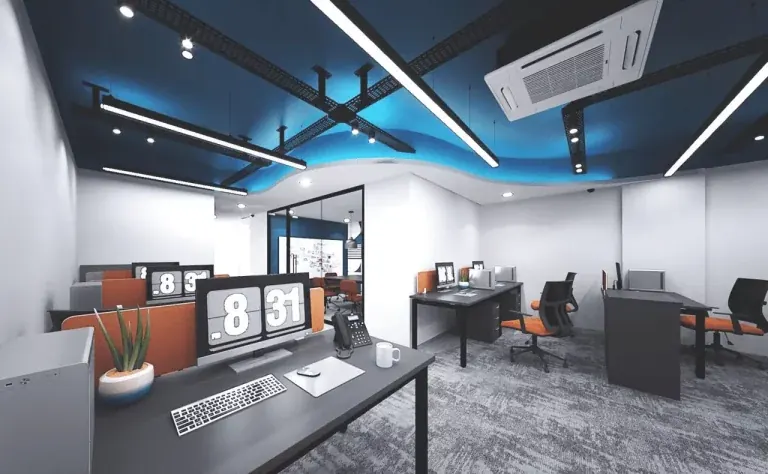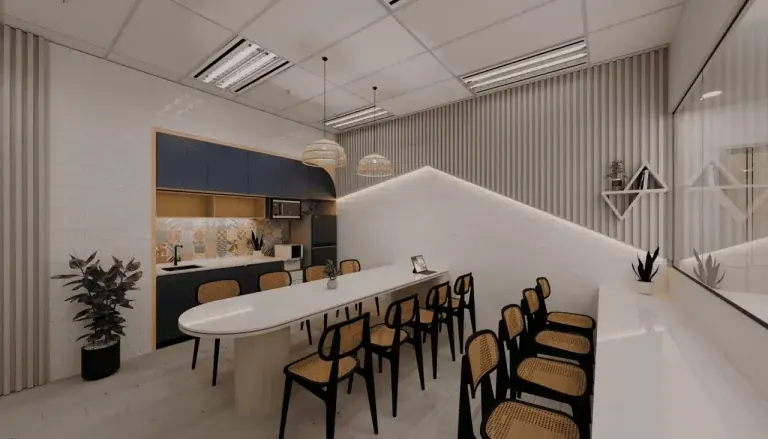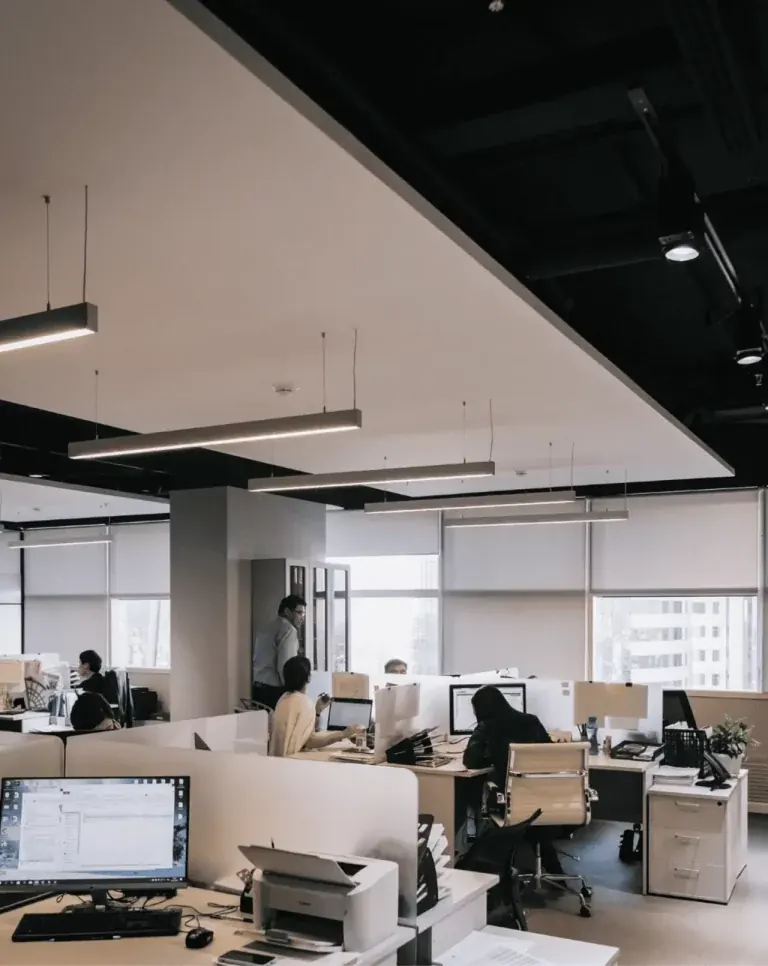
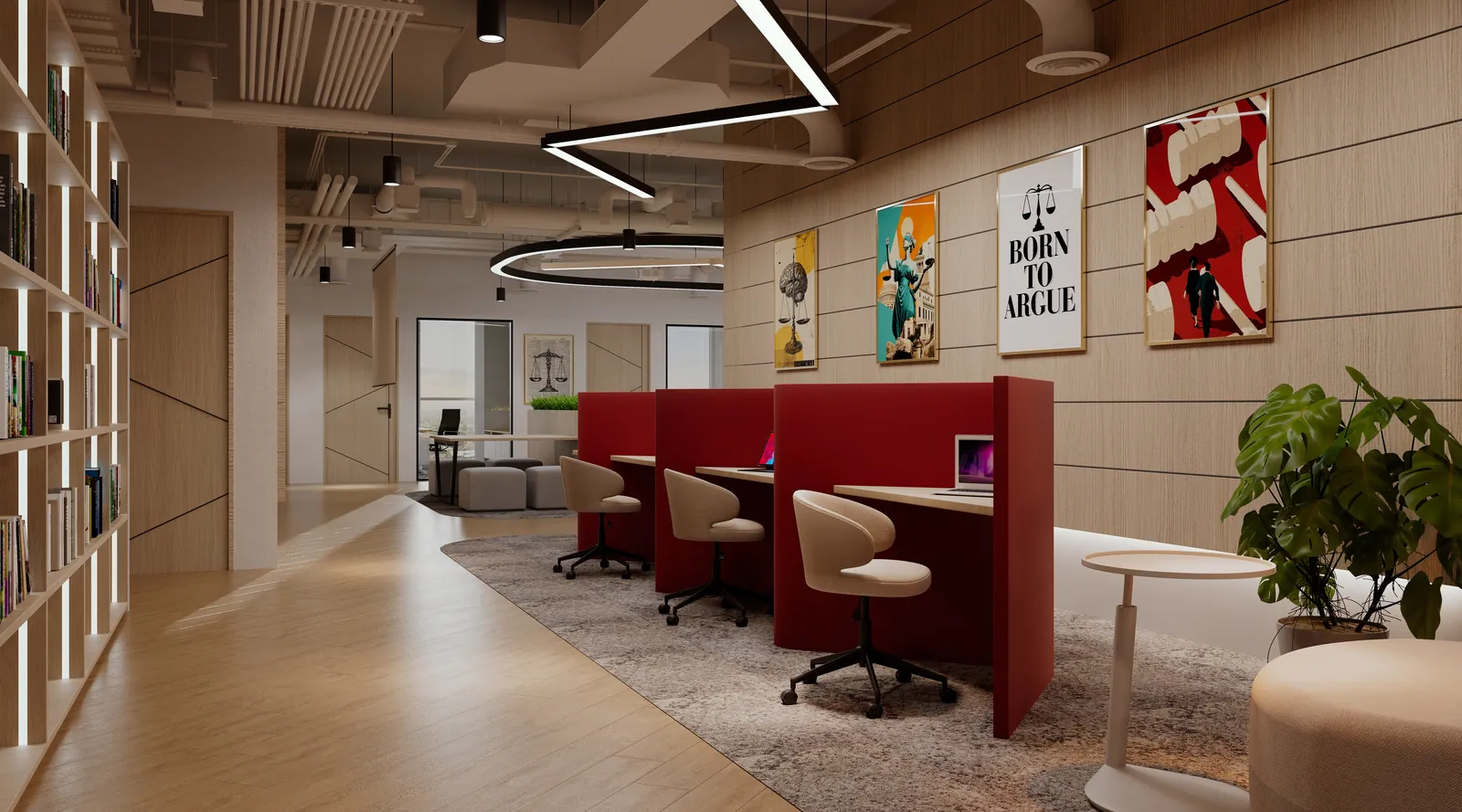
Every January brings a fresh list of office design trends. Most are written for London, New York or Sydney, where many offices sit half-empty on a Friday. Malaysian offices are different. Most staff here still come in most days, the sun is harsher, the air is more humid and power has its own price.
So this guide does not just list what is fashionable. It tests the main office interiors & design trends for 2026 against published data and Malaysian conditions, then sorts them into adopt, adapt or skip. It is written for business owners, office managers and HR or admin leads planning a move or a refit this year.
CTN Interior Solutions has designed and built offices in Malaysia since 2001. The view here comes from that kind of work, backed by public research rather than our own claims.
Planning a refit this year?
A short conversation about your headcount and floor can show which trends are worth the spend. Talk to an office interior design consultant →
The short video below, from a UK workplace design firm, runs through the trends being talked about globally for 2026. The sections that follow test them against Malaysian data.
39 Office Design Must Haves | 2026 Design Trends
Source video: Morgan Lovell, on YouTube
1Which Office Interiors & Design Trends Matter in Malaysia?
Quick Answer: The trends that matter in Malaysia are the ones that fix real daily problems: too few small rooms, too much noise, glare and heat, and crowded peak days. Trends built for half-empty Western offices, such as cutting desks hard or adding large showpiece spaces, need care here because Malaysian offices stay busier.
Most global trend lists repeat the same headings: hybrid layouts, biophilic design, wellness, smart technology and sustainability. A University of Malaya study of Kuala Lumpur high-rise offices found the same direction locally, towards flexible, user-centred space. The headings are fine. The question is how each one should look on a Malaysian floor.
We use three tests for every trend in this guide:
- Is there evidence? Published research or occupancy data, rather than a supplier’s brochure.
- Does it fit Malaysia? Attendance, climate, building stock and local rules.
- Will it last the lease? A trend that looks dated in three years is a cost, not an upgrade.
For the wider picture of how a project runs from brief to handover, see our complete 2026 guide to office interior design in Malaysia.
2How Often Are Malaysian Staff Actually in the Office?
Quick Answer: Most Malaysian white-collar staff still work fully on-site. Monash University Malaysia’s 2026 Employee Wellbeing Index found 80.5% of respondents work fully in the office and 16.5% hybrid. Preferences differ: only 27.1% would choose full-time on-site, and half favour a 3-2 or 4-1 split.
| Arrangement | Actual | % actual | Preferred | % preferred |
|---|---|---|---|---|
| Fully on-site | 80.5% | 27.1% | ||
| Hybrid | 16.5% | – | ||
| 3 days office, 2 remote | – | 30.9% | ||
| 4 days office, 1 remote | – | 19.1% | ||
| Fully remote | 3.0% | 9.3% |
Source: Monash University Malaysia, Employee Wellbeing Index 2026 (238 white-collar respondents), reported by Malaysiakini. Preferred hybrid splits other than 3-2 and 4-1 are not shown, so the preferred column does not total 100%.
The Monash 2026 index, reported by Malaysiakini sampled 238 white-collar workers, so treat it as a signal rather than a census. It matches the Randstad Workmonitor 2024 for Malaysia, where 86% of 517 respondents said they would choose at least three office days a week.
What this means for design:
- Size for the busy day, not the average. If most staff come in most days, deep desk cuts leave people standing on a Tuesday.
- Flexibility is still wanted. Staff want some remote days, so a modest desk-sharing ratio can work for teams that genuinely rotate.
- The office must earn the commute. People come in for each other, so meeting and social space matters more than extra desks.
Our guide to office interior solutions for hybrid work in Malaysia models desk ratios in detail.
3Why Are Small Meeting Rooms and Focus Rooms a 2026 Trend?
Quick Answer: Most meetings are small. HubStar’s occupancy index across 173 buildings found 64% of meetings happen in rooms for four people or fewer, while rooms for 17 or more hosted under 4% of bookings. Offices are swapping some large rooms and open desks for small rooms and enclosed focus spaces.
The HubStar Hybrid Occupancy Index 2025–2026 covered 13 countries from January 2023 to December 2025. Its key findings for layout:
| Finding | Figure | Design response |
|---|---|---|
| Meetings in rooms for 4 or fewer | 64% | Build more 2–4 person rooms |
| Meetings in rooms for 6 or fewer | 78% | Keep only one or two large rooms |
| Large boardrooms: average fill when used | 11.6% | Make the boardroom divisible or multi-use |
| Enclosed offices, 2023 to 2025 | 4% to 10% | Add bookable focus rooms and phone booths |
The rise in enclosed offices reflects demand for somewhere quiet to take a call or think, rather than a private room for every manager. With most Malaysian staff in the office most days, that demand is higher here.
Executive suites follow the same logic. Our article on MD rooms and boardrooms shows how to size them for real use, and our look at open, hybrid and activity-based layouts compares the floor-plate options.
4What Do Employees Want From the Office in 2026?
Quick Answer: Employees want daylight, greenery and space that helps them work. Gensler’s 2025 Global Workplace Survey of more than 16,000 office workers found 40% prioritise natural light and operable windows and 36% prefer greenery, while only 14% want a “corporate” workplace experience.
| Survey finding | Share of workers | % |
|---|---|---|
| Prioritise natural light and operable windows | 40% | |
| Prefer workspaces with greenery | 36% | |
| Strongly agree workplace helps them do their best work | 26% | |
| Want a “corporate” workplace experience | 14% |
Source: Gensler, Global Workplace Survey 2025 press release (16,000+ office workers, 15 countries, 10 industries). Bars are scaled to 50% for readability.
The Gensler 2025 survey also found staff spend about 55% of their week in the office but say they need closer to 65%. That gap is a design brief in itself: people want an office that helps them work.
In Malaysia, light and greenery need local handling:
- Daylight comes with glare and heat. Put focus desks away from west-facing glass and use blinds or solar film.
- Operable windows are rare in towers. Good fresh-air supply does the same job, as our guide to light, air and acoustics explains.
- Plants need a maintenance plan. Humidity helps some species and rots others. Budget for a service contract or choose fewer, larger plants.
Want these trends tested on your own floor?
Our design and build team plans light, rooms and acoustics around your headcount and building. Explore workplace design and build →
5Is Space per Person Growing Again?
Quick Answer: Yes, after two decades of shrinking. British Council for Offices research shows average space per desk fell from 14.8 m² in 2001 to 9.6 m² in 2018. In 2022 the BCO recommended 10 to 12 m² per person, reversing the squeeze to make room for meetings, focus and social space.
| Year | Type | m² per person | sq ft per person | Rent per person a year |
|---|---|---|---|---|
| 2001 | Measured | 14.8 | 159 | RM13,152 |
| 2008 | Measured | 11.8 | 127 | RM10,486 |
| 2013 | Measured | 10.9 | 117 | RM9,687 |
| 2018 | Measured | 9.6 | 103 | RM8,531 |
| 2022 (low) | Recommended | 10.0 | 108 | RM8,887 |
| 2022 (high) | Recommended | 12.0 | 129 | RM10,664 |
Sources: British Council for Offices research via Workplace Insight (measured 2001–2018; 2022 recommendation). Rent column is a CTN Interior modelled estimate: m² × 10.764 × RM6.88 (JLL Q2 2026 Kuala Lumpur average) × 12. Illustrative; excludes service charges.
BCO research reported by Workplace Insight traces the long squeeze, and its 2022 guidance warns that less than 8 m² per person hurts comfort. These are UK figures, but the direction matches what Malaysian tenants are asking for: fewer, better-used desks and more shared rooms.
Space is rent. At JLL’s Q2 2026 Kuala Lumpur average of RM6.88 per sq ft, each extra square metre per person costs about RM889 a year. For 50 staff, moving from 10 to 12 m² each adds roughly RM88,900 a year. That is why this trend should be planned with a proper floor plan, not guessed.
6Why Is Acoustic Design a Top Office Trend?
Quick Answer: Noise is the most common complaint in open offices. Leesman’s data from over 600,000 employees shows only 35% were satisfied with noise in 2023, 33% in 2024 and about 36% in 2025. Those unhappy with noise were 46 points less likely to say the office lets them work productively.
The Leesman noise analysis also found 89% of employees rate focused work as important, yet even the best-rated workplaces only reach 45% noise satisfaction.
Controlled studies point the same way. A 2020 PLOS ONE study at Booking.com in Amsterdam moved 22 teams through four layouts. Zoned open plan beat plain open plan on self-rated productivity by 17%. Fully activity-based working scored lowest.
Practical acoustic moves for a Malaysian fit-out:
- Zone the floor. Keep noisy teams, pantries and printers away from focus areas.
- Treat ceilings first. Acoustic ceiling tiles or baffles do more than desk screens in most open areas.
- Seal meeting rooms properly. Run partitions to the slab or add ceiling barriers, or conversations leak over the top.
Noise is one of the problems covered in our guide to office design solutions for 8 common workplace problems.
7Are Sustainable Office Interiors Worth It in Malaysia?
Quick Answer: Yes, when the choices cut running costs or last longer. Efficient LED lighting with sensors, good air-conditioning zoning and durable finishes pay back through lower bills and fewer replacements. Certified green labels add value mainly when a landlord, investor or head office asks for them.
Power is the easiest place to start. Bernama reported a 45.40 sen per kWh average base tariff from July 2025, so lighting and cooling that run 50 hours a week add up quickly. Practical moves:
- LED with occupancy and daylight sensors in meeting rooms, store rooms and perimeter zones.
- Air-conditioning zoning so a late-working team does not cool the whole floor.
- Durable, low-emission finishes that suit humidity and last the lease, which our guide to materials that last covers.
- Reuse where sensible. Keeping good partitions and furniture is often greener than replacing them.
For certification routes, see our comparison of GBI, GreenRE and LEED for offices, and for reporting-driven projects, our guide to ESG office interior design in Malaysia.
Refitting an older floor?
Our office fit-out team can upgrade lighting, cooling zones and finishes while keeping what still works. See our office fit-out service →
8Which 2026 Office Trends Should You Adopt, Adapt or Skip?
Quick Answer: Adopt small rooms, acoustic zoning, efficient lighting and daylight planning. Adapt greenery, desk sharing, modular furniture and smart booking tools to Malaysian conditions. Skip or limit hot-desking for everyone, oversized boardrooms and heavily themed décor, which date fast and suit fewer Malaysian offices.
| Trend | Evidence | Malaysian fit | Lifespan | Verdict |
|---|---|---|---|---|
| Small meeting and focus rooms | Strong | High | Long | Adopt |
| Acoustic zoning and ceilings | Strong | High | Long | Adopt |
| LED lighting with sensors | Strong | High | Long | Adopt |
| Daylight with glare control | Strong | Medium | Long | Adopt |
| Greenery and planting | Moderate | Medium | Medium | Adapt |
| Modest desk sharing | Moderate | Medium | Medium | Adapt |
| Modular, movable furniture | Moderate | High | Medium | Adapt |
| Smart booking and sensors | Moderate | Medium | Short | Adapt |
| Hot-desking for everyone | Weak | Low | Medium | Skip |
| Heavily themed or trend-colour décor | Weak | Medium | Short | Skip |
Illustrative scorecard by CTN Interior. Evidence ratings draw on the HubStar, Leesman, Gensler, BCO and PLOS ONE sources cited in this article; fit and lifespan are judgement calls. Your brief may change a rating.
Trends that fix a measured problem score well and last. Trends that are mainly a look date fastest.
Hot-desking scores low here because the Monash data shows most Malaysian staff are in most days. It can still suit a sales team that is genuinely out of the office. Our comparison of freelancers, studios and design and build firms helps you choose who should run a trend-led refit.
9How Do You Apply Office Design Trends Without Dating Your Office?
Quick Answer: Start from your own data. Count attendance and meeting sizes, list the complaints, then choose trends that fix them. Put trend-led looks into paint, loose furniture and graphics, and keep walls, ceilings and services neutral so the office can change without a rebuild.
- Measure your peak day: Count desks in use on your busiest day for two to four weeks.
- Log meeting sizes: Check room bookings to see how many people really meet at once.
- List the top complaints: Ask staff about noise, heat, glare and lack of rooms.
- Match trends to problems: Pick only trends from the scorecard that fix a listed problem.
- Keep the shell neutral: Put bold colour and style into items you can replace cheaply.
- Review after six months: Recheck use and complaints, then adjust furniture and room booking.
A clear brief makes this easier, and our guide to writing an office design brief shows the sections to include. For ready-made answers to the most common problems, see our eight office design solutions.
10Conclusion: Follow the Evidence, Not the Mood Board
Quick Answer: The strongest office interiors & design trends for 2026 are practical: small rooms, quiet zones, daylight without glare, sensible space per person and efficient services. Malaysian offices stay busy, so plan for the peak day and keep fashion in the finishes you can swap later.
Trend lists change every year. A floor that fits how your people work dates far more slowly. When you are ready to test these ideas on your own space, our office interior design consultants can start from your headcount, attendance and lease.
11Frequently Asked Questions
1. What are the biggest office design trends in Malaysia for 2026?
More small meeting and focus rooms, acoustic zoning, daylight with glare control, greenery, efficient lighting and modest desk sharing. Each works best when matched to measured attendance and complaints rather than copied from a global list.
2. Is hot-desking a good idea for Malaysian offices?
Rarely for a whole company. Survey data shows most Malaysian white-collar staff still work on-site most days. Desk sharing suits teams that are genuinely out of the office, such as sales or field staff.
3. Is biophilic design practical in a Malaysian office?
Yes, if planned for local conditions. Choose plants that suit air-conditioned interiors, budget for maintenance and control glare from large windows. A few well-kept plants beat a neglected living wall.
4. How much space per person should a 2026 office plan for?
The British Council for Offices recommends 10 to 12 m² per person, about 108 to 129 sq ft. Test the right figure for your attendance and rent on a floor plan.
5. How do I stop a new office looking dated in a few years?
Keep walls, ceilings and building services neutral and well built. Put trend colours and styles into paint, graphics and loose furniture that can be changed cheaply when tastes move on.
Ready to plan an office that lasts?
Share your floor size, headcount and timing. We will tell you which 2026 trends are worth it for your space and which to skip.
Book a free consultation →